


Lower back pain is one of the most common reasons for visiting a neurologist among working-age people.According to statistics, 9 out of 10 people have experienced discomfort in the lower back at least once in their entire life, and about 9% of cases result in disability.The first episode is most often recorded before the age of 30.From 30 to 60 years old, the risk of morbidity increases.
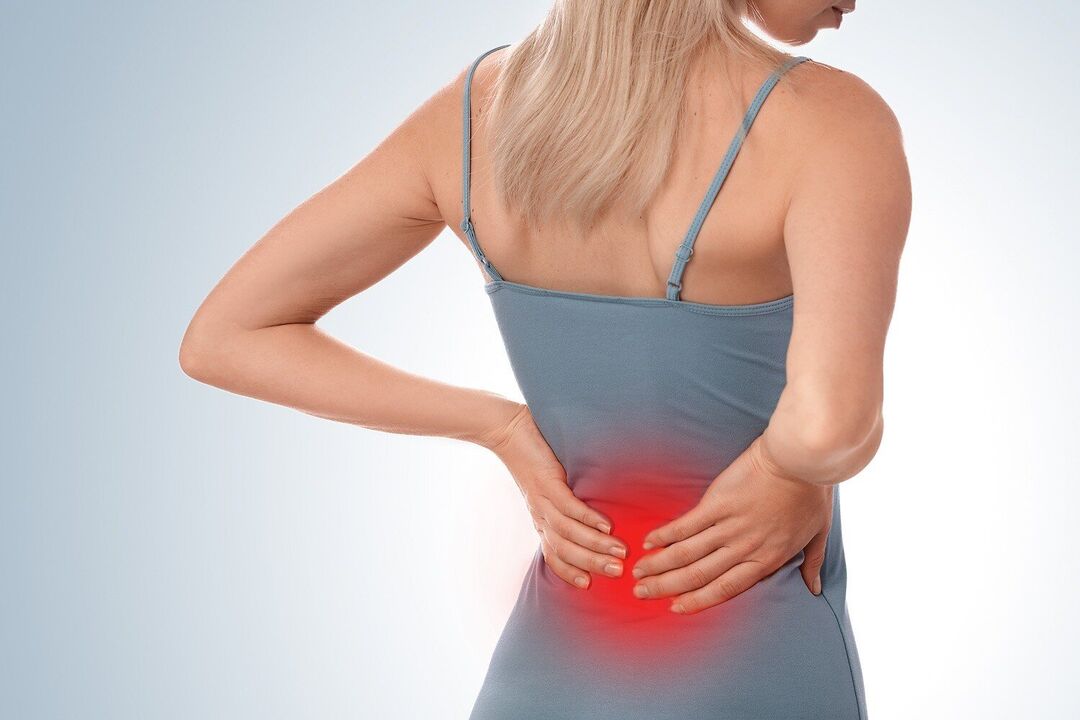
Unfortunately, young people don't always pay attention to the warning signs.Many people believe that back pain is due to overwork, physical activity or long time at the computer.But in fact, it can be a symptom of a serious illness.Back pain can be caused by a number of pathologies: from spinal problems to kidney failure.Only a timely visit to a doctor will help determine the cause and carry out appropriate treatment.
Possible causes of back pain: what hurts?
Ankylosing spondylitis
Lumbar pain syndrome occurs due to fusion of the vertebrae into a large conglomeration.The rear loses mobility in the lower part.With ankylosing spondylitis, calcium deposits are also seen in the ligaments that support the spine, which also causes pain when you try to turn, stand up, or perform other activities.
Distinctive symptoms of pathology:
- stiffness of body movements in the lumbar region;
- increased pain after prolonged immobility, especially after sleeping at night.
Osteochondrosis
The disease manifests as thinning of the intervertebral discs.As a result, the shock-absorbing function of the spine decreases, the nerve roots are tightened and the muscles around the affected area spasm.The person feels acute pain.Without treatment, osteochondrosis progresses, leading to disc protrusions and herniations.The stretching of the cartilage compresses the spinal cord.A person not only has severe pain in the lower back, but also the innervation of the lower extremities is interrupted.
Distinctive signs of osteochondrosis:
- the pain intensifies when you try to turn from your back to your stomach, when you get up from a horizontal or sitting position, or when you bend over;
- Patients often report weakness and numbness in one or both legs.
Spondyloarthrosis
The lower back can hurt due to degenerative changes in the cartilage tissue that covers the intervertebral discs.Elastic layers become thinner and osteophytes appear in their place - hard bone formations.The distance between the vertebrae decreases with simultaneous compression of the spinal canal.
The nature of pain in spondyloarthrosis:
- accompanied by limited movement of the spine in the lower back, up to constant stiffness;
- worsens after walking, prolonged sitting, standing and other stress;
- radiates to the pelvic area and thighs.
Urolithiasis
An attack of pathology is manifested by sharp, strong pain in the back on the side of the affected kidney.The severity and nature of the sensation do not change depending on the position of the body.The patient cannot find a position in which it would be even a little easier.
An attack of urolithiasis is accompanied by additional specific symptoms:
- back pain in the lower back;
- the volume of urine decreases, its color changes and blood impurities appear;
- pain appears during urination;
- There may be an increase in temperature due to inflammation.
Other causes of pain and cramps in the lower back
Low back pain syndrome is observed in the following conditions:
- pregnancy, including early pregnancy;
- algomenorrhea in women;
- osteomyelitis;
- appendicitis;
- inflammation of the pancreas;
- intestinal pathologies;
- back injury;
- tumor in the lumbar region;
- inflammatory processes in the female genital organs;
- prostatitis in men, etc.
Expert opinion
Pain in the lower back: what to do?Do not make sudden movements, especially if the pain appears as a result of a fall or blow.Try to get the most comfortable position.If the pain is acute and does not subside when you change position, call an ambulance - renal colic is likely, which requires hospitalization.In other cases, you can use ointments and tablets to relieve the condition.Contact a specialist as soon as possible.The doctor will help relieve severe pain and prescribe treatment.
Diagnosis of back pain
At the first appointment, the doctor can make a block to relieve acute pain.When the patient feels better, the doctor performs a more complete examination and collects the history.It is important to clarify the location, nature, duration of pain, factors that cause deterioration or, conversely, improve well-being.The doctor will ask about past injuries and illnesses, beginning in early childhood.The history helps to suggest why the back hurts and which diagnostic procedures will provide more complete information.
The doctor may prescribe:
- General analysis of urine and blood.Based on the results, they diagnose inflammatory processes, determine the signs of pathology of the kidneys and digestive organs;
- Ultrasound of the kidneys and urinary system.An examination is necessary if urolithiasis is suspected.Using ultrasound, the doctor determines the localization and extent of the spread of the inflammatory process, evaluates the size of the stones in order to correctly construct treatment tactics;
- X-ray of the lumbar spine.The images help to determine the pathology of the vertebrae and adjacent tissues.To clarify X-rays, CT or MRI are additionally prescribed - these are the most informative examination methods;
- Ultrasound of the pelvic organs.When a woman has pain in the lower back, this may indicate endometritis or salpingoophoritis.Pregnant women should be examined to determine the tone of the uterus;
- Ultrasound of the prostate gland.If a man has pain in the lower back, this may be a sign of inflammation or a prostate tumor.The doctor performs a TRUS to determine the structure of the gland.
After a general examination, the doctor can prescribe more targeted procedures.In some cases, consultation with a surgeon, therapist, gynecologist and other specialists is required to clarify the diagnosis.
Back pain treatment
Therapy is strictly individual.The doctor begins to treat the patient when he receives the most complete information about his condition or at least has data to suggest a diagnosis.Therapy for renal colic and osteochondrosis is fundamentally different.
Drug treatment
To reduce pain, non-steroidal anti-inflammatory drugs are most often prescribed in the form of injections, ointments and tablets.Medicines help to quickly relieve inflammation and muscle spasms.Nonsteroidal anti-inflammatory drugs have side effects, so the doctor accurately calculates the dose and duration of the course for each patient.
If the treatment of back pain does not bring results within 2-3 days, the doctor chooses hormonal medications.Medicines are only needed to relieve an acute condition.Antispasmodics, decongestants and B vitamins are prescribed as adjunctive agents.If the patient has lower back pain and pain during urination, antibiotics may be chosen.The doctor will tell you why this or that medicine is needed and how to take it correctly.
Non-drug treatment
Procedures are carried out in courses after relief of irritation.In the complex treatment of pain, the following are used:
- physiotherapy: radiofrequency neuromodulation, electrophoresis, phonophoresis, magnetic therapy;
- physical therapy: a set of daily exercises chosen by a doctor, exercises in the pool;
- massage: therapeutic on the lower back and buttocks and general strengthening;
- acupuncture, hirudotherapy and other procedures.
Surgical treatment
The operation is performed strictly according to the indications.If the patient has pain in the lower back and has a temperature that does not decrease while taking medications, removal of the inflammatory focus will be required.Radical intervention is necessary for tumors and metastases.
In case of pathology of the female genital organs, when the lower abdomen hurts, diagnostic curettage and laparoscopic operations are performed.If urolithiasis cannot be removed with the help of medications, the patient is also indicated for surgical treatment.
You cannot tolerate pain and discomfort in the lower back.The body gives you a signal that you should pay attention to this area.